Complete Roadmap to Become a DevOps Engineer in 2026: Step-by-Step Career Guide
DevOps has become one of the most important technology skills for organizations building, deploying, and managing modern applications. Companies are moving applications to the cloud, automating infrastructure, adopting containers, implementing continuous delivery, and using monitoring and security tools to improve reliability.
This has created strong career opportunities for professionals who understand both development and IT operations. However, becoming a DevOps Engineer is not about learning one particular tool. A successful DevOps career requires a combination of Linux, networking, scripting, Git, cloud computing, automation, containers, CI/CD, infrastructure as code, monitoring, security, and real-world troubleshooting.
If you are wondering how to become a DevOps Engineer in 2026, this complete roadmap will help you understand what to learn, in what order to learn it, which tools are important, and how to build practical experience.
What Does a DevOps Engineer Do?
A DevOps Engineer helps development and operations teams work together to build, test, deploy, monitor, and maintain applications efficiently.
A typical DevOps Engineer may be responsible for:
- Managing Linux servers and cloud infrastructure.
- Creating CI/CD pipelines.
- Automating application deployments.
- Building and managing Docker containers.
- Managing Kubernetes environments.
- Creating infrastructure using Terraform.
- Automating configuration using Ansible.
- Monitoring applications and infrastructure.
- Managing cloud services on AWS, Azure, or Google Cloud.
- Implementing security practices in development and deployment.
- Troubleshooting production issues.
- Improving application reliability and deployment speed.
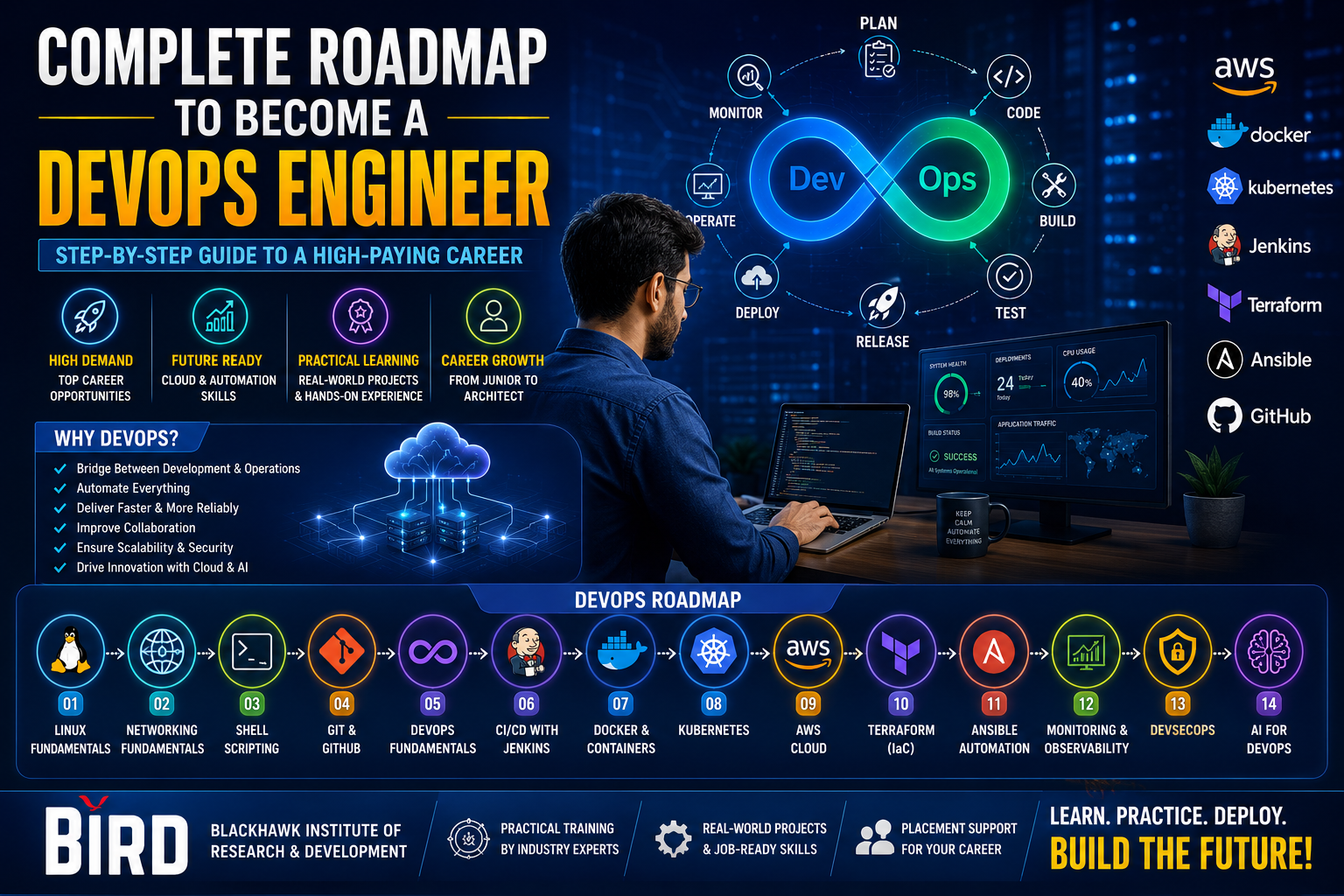
DevOps Roadmap at a Glance
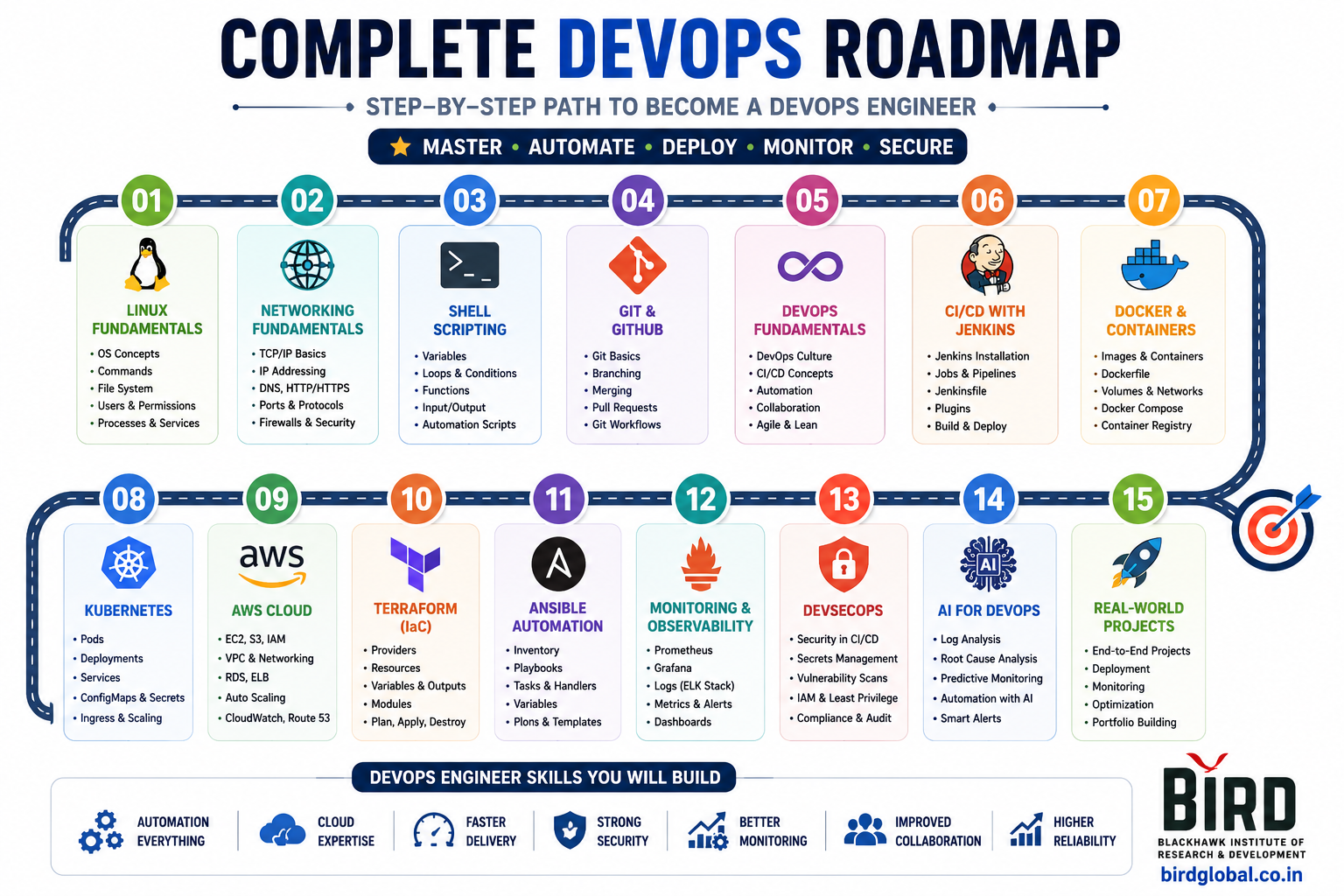
A practical DevOps learning journey can be divided into the following stages:
| Stage | What to Learn |
|---|---|
| 1 | Linux & Operating Systems |
| 2 | Networking Fundamentals |
| 3 | Shell Scripting |
| 4 | Git & GitHub |
| 5 | DevOps Fundamentals |
| 6 | CI/CD & Jenkins |
| 7 | Docker & Containers |
| 8 | Kubernetes |
| 9 | AWS Cloud |
| 10 | Terraform & Infrastructure as Code |
| 11 | Ansible & Configuration Management |
| 12 | Monitoring & Observability |
| 13 | DevSecOps |
| 14 | AI for DevOps |
| 15 | Real-World Projects & Interview Preparation |
1. Learn Linux Fundamentals
Linux should be one of the first technologies you learn on your DevOps journey. A large portion of modern application infrastructure runs on Linux-based systems.
You do not need to become a Linux kernel expert, but you should be comfortable working from the command line.
Important Linux Topics
- Linux file system
- Files and directories
- File permissions
- Users and groups
- Processes
- Services
- Package management
- SSH
- Environment variables
- Disk management
- Log management
- Networking commands
- Crontab
- Process monitoring
- System troubleshooting
Important commands include ls, cd, cp, mv, rm, find, grep, awk, sed, ps, top, df, du, chmod, chown, systemctl, curl, ss, and ssh.
2. Learn Networking Fundamentals
DevOps Engineers frequently troubleshoot connectivity, DNS, ports, load balancers, firewalls, and application communication. Therefore, networking knowledge is extremely important.
Topics to Learn
- IP addresses
- IPv4 and IPv6 basics
- TCP/IP
- TCP vs UDP
- DNS
- HTTP and HTTPS
- Ports
- SSH
- Subnetting
- Routing
- Firewalls
- Load balancing
- Proxies
- Public and private networks
Understanding networking will make AWS, Kubernetes, Docker, and troubleshooting much easier later.
3. Learn Shell Scripting
Automation is at the heart of DevOps. Before moving into advanced automation tools, learn how to automate everyday Linux tasks using shell scripting.
Learn:
- Variables
- Conditions
- Loops
- Functions
- Command-line arguments
- Exit status
- Input and output
- Redirection
- Pipes
- Text processing
- Automation scripts
For example, you should eventually be able to write a script that checks disk usage, verifies whether a service is running, creates backups, analyzes logs, or restarts a failed service.
4. Master Git and GitHub
Git is fundamental to modern software development and DevOps workflows. DevOps Engineers need to understand how source code moves from developers into automated build and deployment pipelines.
Important Git Commands
git clonegit initgit addgit commitgit pushgit pullgit branchgit mergegit checkoutgit rebasegit stashgit log
Also Learn
- Branches
- Pull requests
- Merge conflicts
- Git workflows
- Code reviews
- GitHub repositories
- GitHub Actions basics
5. Understand DevOps Fundamentals
Before learning dozens of tools, understand what DevOps actually means.
Important Concepts
- Continuous Integration
- Continuous Delivery
- Continuous Deployment
- Infrastructure as Code
- Configuration Management
- Automation
- Version Control
- Monitoring
- Observability
- Infrastructure automation
- Release management
- Incident management
The goal is not simply to memorize tools. You should understand why each tool is used and where it fits into the software delivery lifecycle.
6. Learn CI/CD with Jenkins
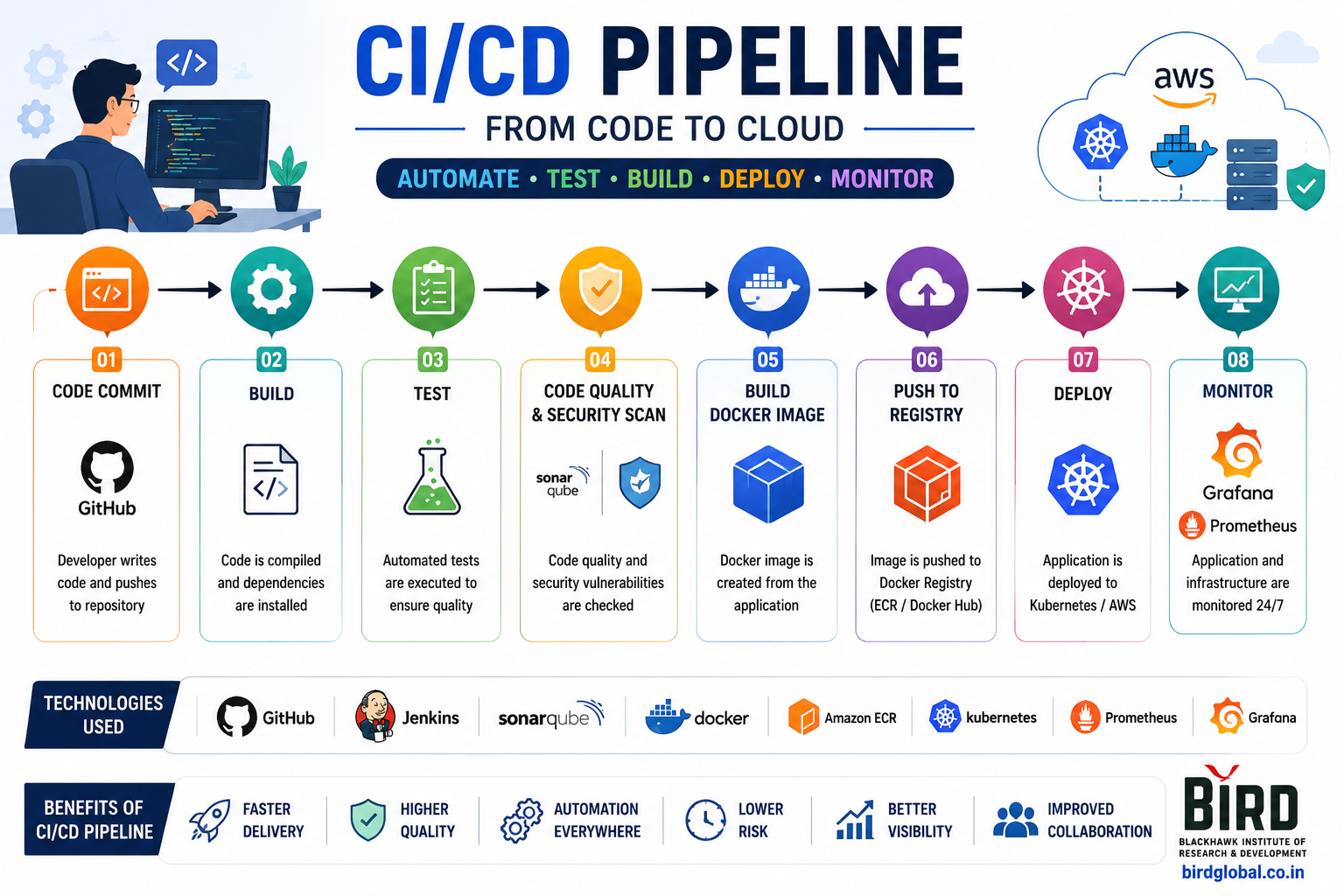
Continuous Integration and Continuous Delivery are central components of DevOps.
A typical pipeline may look like:
Developer → Git → Build → Test → Docker Image → Security Scan → Deployment → Monitoring
Jenkins is one of the popular tools used for implementing CI/CD pipelines.
Jenkins Topics
- Jenkins installation
- Jobs
- Pipeline concepts
- Jenkinsfile
- Build automation
- Git integration
- Credentials
- Webhooks
- Agents
- Pipeline stages
- Automated deployment
You should build pipelines yourself instead of only watching tutorials.
7. Learn Docker and Containerization
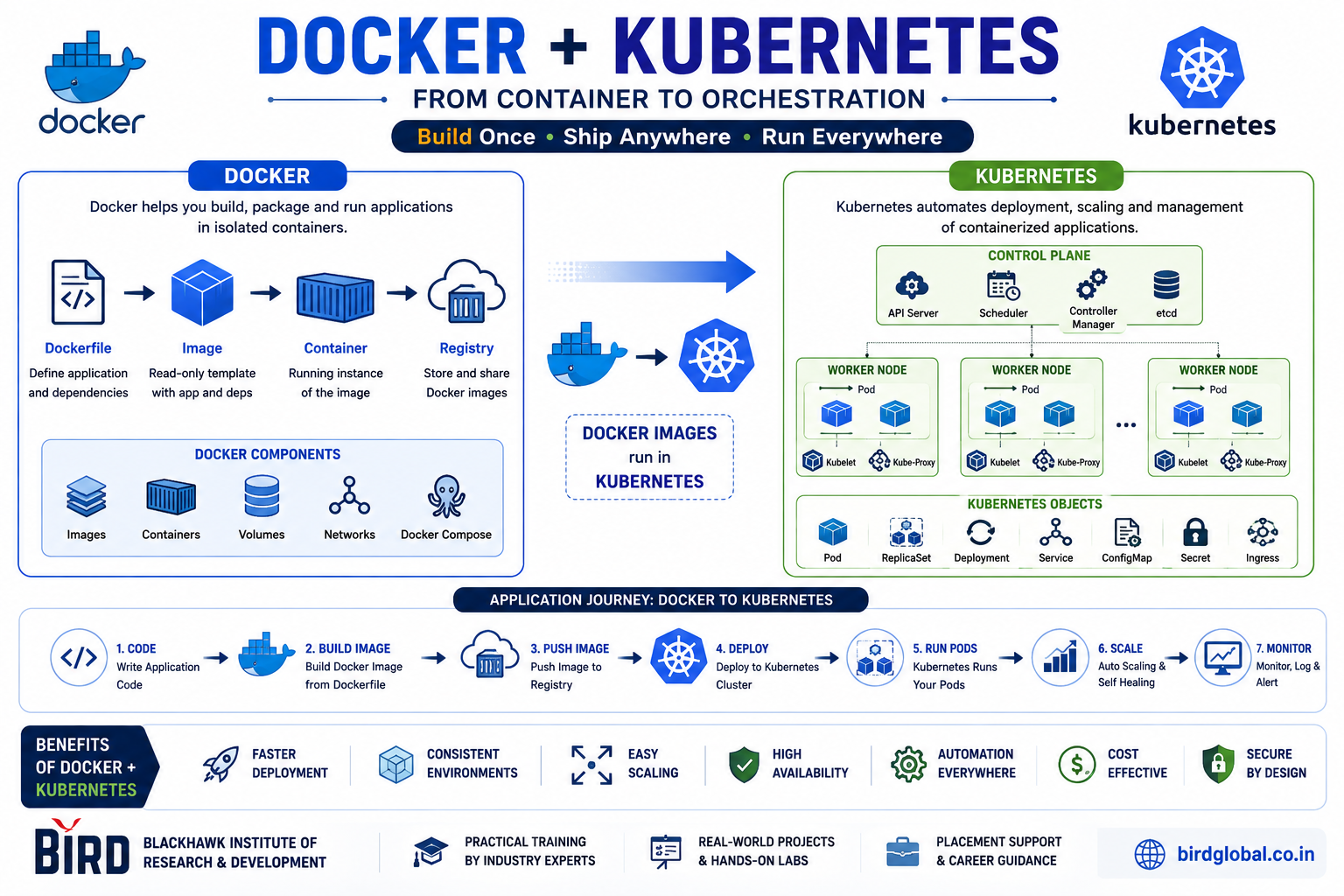
Docker allows applications and their dependencies to be packaged into portable containers.
Docker Topics
- Images
- Containers
- Dockerfile
- Docker commands
- Volumes
- Networks
- Environment variables
- Docker Compose
- Container registries
- Multi-stage builds
A good project at this stage is to containerize a web application and create a Docker Compose configuration containing the application, database, and supporting services.
8. Master Kubernetes
Kubernetes is an important technology for managing containerized applications at scale.
Important Kubernetes Concepts
- Pods
- Deployments
- Services
- Namespaces
- ConfigMaps
- Secrets
- Volumes
- Ingress
- ReplicaSets
- Resource limits
- Health checks
- Rolling deployments
- Autoscaling
Do not try to memorize Kubernetes commands without understanding the architecture. Learn how the control plane, worker nodes, pods, services, and controllers work together.
9. Learn AWS Cloud
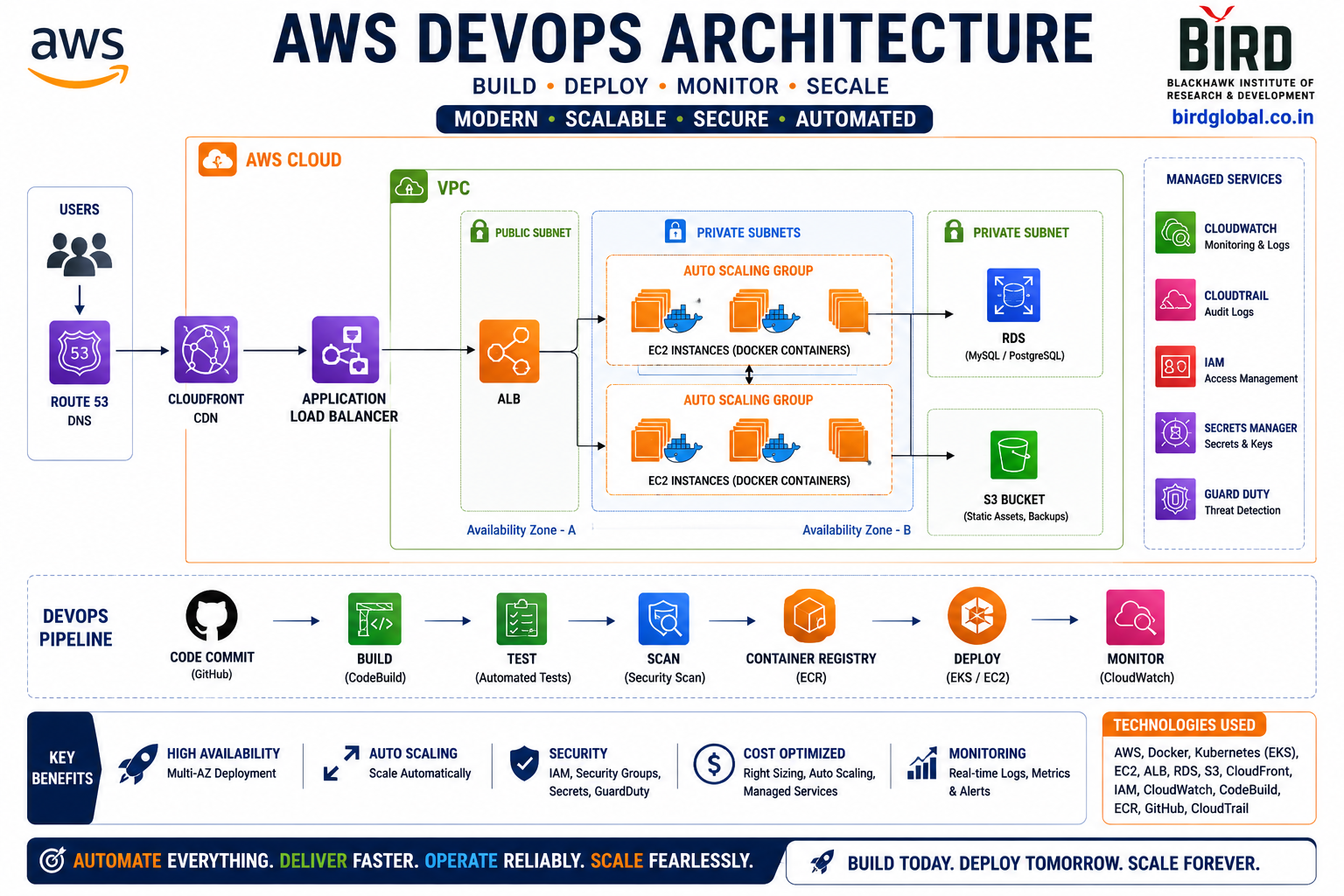
Cloud computing is an important part of modern DevOps. AWS is widely used for deploying applications, managing infrastructure, storing data, monitoring systems, and implementing scalable architectures.
AWS Services to Learn
- EC2
- S3
- IAM
- VPC
- Security Groups
- RDS
- Load Balancers
- Auto Scaling
- Route 53
- CloudWatch
- ECR
- ECS
- EKS
- Lambda
You do not need to memorize every AWS service. Focus on understanding how services are combined to build reliable and secure applications.
10. Learn Terraform and Infrastructure as Code
Infrastructure as Code allows infrastructure to be created and managed using configuration files instead of manually creating resources through a cloud console.
Terraform is widely used for infrastructure automation.
Terraform Topics
- Providers
- Resources
- Variables
- Outputs
- Modules
- State
- Remote state
- Terraform plan
- Terraform apply
- Terraform destroy
A strong project is to create an AWS environment using Terraform rather than manually creating every resource.
11. Learn Ansible
Ansible is useful for configuration management and automation.
Learn:
- Inventory
- Playbooks
- Tasks
- Variables
- Handlers
- Roles
- Templates
- Ad-hoc commands
For example, you can use Ansible to install packages, configure web servers, create users, deploy applications, and maintain server configurations.
12. Learn Monitoring and Observability
A deployment is not complete simply because the application is running. DevOps teams need to know whether the application is healthy and how it behaves in production.
Important Monitoring Areas
- CPU utilization
- Memory utilization
- Disk usage
- Network traffic
- Application logs
- Error rates
- Response time
- Availability
- Infrastructure health
Tools to Explore
- Prometheus
- Grafana
- ELK Stack
- OpenSearch
- CloudWatch
Learn the difference between metrics, logs, and traces and understand how they help troubleshoot production systems.
13. Add DevSecOps Skills
Security should not be treated as something that happens only after deployment. Modern DevOps teams increasingly integrate security into development and deployment pipelines.
DevSecOps Topics
- Secrets management
- IAM
- Least privilege
- Container security
- Dependency scanning
- Vulnerability scanning
- Infrastructure security
- Secure CI/CD pipelines
- Security testing
The goal is to identify and address security problems as early as possible in the software delivery process.
14. Learn AI for DevOps
AI is increasingly becoming a productivity tool for DevOps teams. Instead of replacing fundamental DevOps knowledge, AI can help engineers analyze information, automate repetitive tasks, and troubleshoot complex systems.
AI Applications in DevOps
- Log analysis
- Incident summarization
- Root-cause analysis assistance
- Generating deployment scripts
- Writing infrastructure code
- Creating shell scripts
- Analyzing monitoring alerts
- Documentation generation
- CI/CD troubleshooting
- Automation assistance
However, you should first learn the underlying technology. An engineer who understands Linux, networking, cloud, containers, and CI/CD will get much more value from AI tools than someone who only knows how to generate commands.
15. Build Real-World DevOps Projects
Projects are one of the most important parts of becoming job-ready. Watching videos and completing tutorials is not enough.
Project 1: CI/CD Pipeline
Create a complete pipeline that:
- Pulls source code from GitHub.
- Builds the application.
- Runs tests.
- Creates a Docker image.
- Pushes the image to a container registry.
- Deploys the application.
- Monitors the application.
Project 2: AWS Infrastructure with Terraform
Build an AWS environment using Terraform containing networking, compute, security, and application infrastructure.
Project 3: Kubernetes Deployment
Deploy a containerized application to Kubernetes and configure services, health checks, scaling, and ingress.
Project 4: Monitoring Dashboard
Build a monitoring solution using Prometheus and Grafana and create dashboards for CPU, memory, application performance, and infrastructure health.
Project 5: Complete DevOps Project
Combine everything into one project:
GitHub → Jenkins → Docker → Registry → Kubernetes/AWS → Terraform → Monitoring → Security → AI-assisted Troubleshooting
This type of project can become an excellent portfolio project when documented properly.
DevOps Learning Roadmap by Experience Level
| Level | Focus |
|---|---|
| Beginner | Linux, Networking, Shell Scripting, Git |
| Intermediate | Jenkins, Docker, AWS, CI/CD |
| Advanced | Kubernetes, Terraform, Ansible, Monitoring |
| Professional | DevSecOps, Cloud Architecture, Reliability, Automation |
| Future Ready | AI for DevOps, AIOps and intelligent automation |
How Long Does It Take to Become a DevOps Engineer?
The learning time depends on your existing technical background and the amount of practical work you do.
A beginner should focus on building a strong foundation rather than trying to learn every DevOps tool immediately. Someone with Linux, networking, programming, or system administration experience can generally move through the foundational stages faster.
A practical learning approach is:
- Foundation: Linux, networking, scripting and Git.
- Automation: CI/CD, Jenkins and scripting.
- Containers: Docker and Kubernetes.
- Cloud: AWS and cloud networking.
- Infrastructure: Terraform and Ansible.
- Operations: Monitoring and observability.
- Security: DevSecOps.
- Advanced: AI-assisted DevOps and automation.
Consistency and hands-on practice are more important than simply completing a course quickly.
Common Mistakes DevOps Beginners Should Avoid
- Trying to learn every DevOps tool at the same time.
- Ignoring Linux fundamentals.
- Ignoring networking.
- Memorizing commands without understanding concepts.
- Learning Kubernetes before understanding containers.
- Learning Terraform without understanding cloud infrastructure.
- Watching tutorials without building projects.
- Ignoring troubleshooting skills.
- Focusing only on certifications.
- Copying AI-generated commands without understanding them.
DevOps Engineer Career Path
DevOps can provide multiple career progression opportunities. A professional may start with infrastructure or system administration responsibilities and gradually move toward DevOps, cloud, platform engineering, site reliability engineering, or cloud architecture.
A possible career progression is:
Linux/System Administrator → Junior DevOps Engineer → DevOps Engineer → Senior DevOps Engineer → Cloud/Platform Engineer → DevOps Architect
The exact career path varies between organizations, but continuously improving automation, cloud, reliability, security, and system design skills can open additional opportunities.
DevOps Skills Checklist
| Skill | Priority |
|---|---|
| Linux | Essential |
| Networking | Essential |
| Shell Scripting | Essential |
| Git | Essential |
| CI/CD | Essential |
| Docker | Essential |
| Kubernetes | Advanced |
| AWS/Cloud | Essential |
| Terraform | Advanced |
| Ansible | Useful |
| Monitoring | Essential |
| DevSecOps | Advanced |
| AI for DevOps | Future-ready |
Final Thoughts
Becoming a DevOps Engineer is a journey rather than a single course or certification. The strongest DevOps professionals understand the fundamentals and then use tools to solve real business and infrastructure problems.
Start with Linux, networking, scripting and Git. Then progress into CI/CD, Docker, Kubernetes, AWS, Terraform, Ansible, monitoring and security. Once your fundamentals are strong, add AI-assisted automation and troubleshooting to your skill set.
Most importantly, build real projects. Deploy applications, break your infrastructure, troubleshoot failures, automate repetitive tasks, monitor systems, and document everything you learn.
If you consistently follow this roadmap and combine learning with hands-on practice, you can build a strong foundation for a career in DevOps, Cloud Engineering, Platform Engineering, SRE, and related technology roles.
🚀 Ready to Start Your DevOps Journey?
At BIRD – Blackhawk Institute of Research & Development, you can learn DevOps through practical, industry-focused training covering Linux, Git, CI/CD, Docker, Kubernetes, AWS, Terraform, Ansible, monitoring, DevSecOps and AI-assisted DevOps practices.
Learn. Practice. Build Projects. Become Job Ready.